

Public Relations Strategic Plan Powerpoint Ppt Template Bundles





Try Before you Buy Download Free Sample Product
 Impress Your
Audience
 100%
Editable
 Save Hours
of Time


Our Public Relations Strategic Plan Powerpoint Ppt Template Bundles are topically designed to provide an attractive backdrop to any subject. Use them to look like a presentation pro.
People who downloaded this PowerPoint presentation also viewed the following :
Content of this Powerpoint Presentation
Slide 1: This slide showcase title Public Relations Strategic Plan. State Your Company Name.
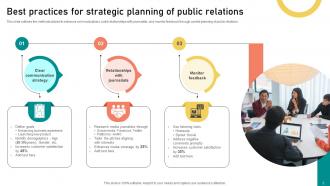
Slide 2: This slide outlines the methods utilized to enhance communications, build relationships, and monitor feedback through careful planning of public relations.
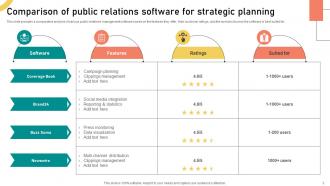
Slide 3: This slide provides a comparative analysis of various public relations management software.
Slide 4: This slide outlines strategies to enhance production such as streamlining with technology, optimizing inventory management, etc.
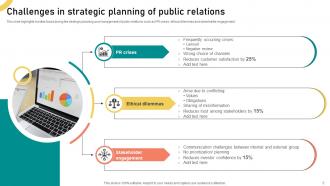
Slide 5: This slide highlights hurdles faced during the strategic planning and management of public relations such as PR crises, ethical dilemmas and stakeholder engagement.
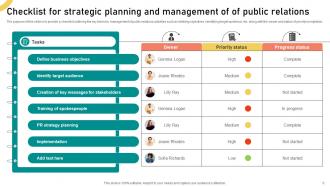
Slide 6: This slide is to provide a checklist outlining the key tasks for management of public relations activities.
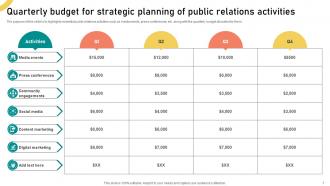
Slide 7: This slide is to highlights essential public relations activities such as media events, press conferences, etc.
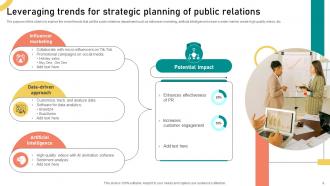
Slide 8: This slide is to explore the recent trends that aid the public relations department.
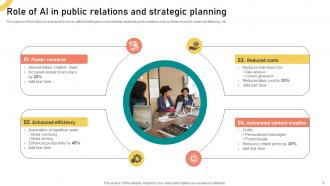
Slide 9: This slide is to examine the role of artificial intelligence in the activities related to public relations such as faster research, enhanced efficiency, etc.
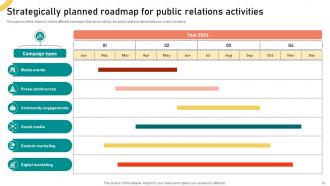
Slide 10: This slide is to outline different campaigns that can be held by the public relations department over a year’s timeline.
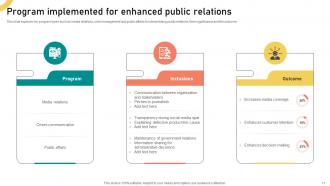
Slide 11: This slide explores key program types such as media relations, crisis management and public affairs for streamlining public relations, their significance and the outcome.
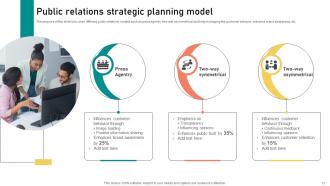
Slide 12: This slide is to cover different public relations models such as press agentry, two-wat asymmetrical and help in shaping the customer behavior.
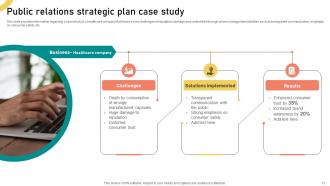
Slide 13: This slide provides information regarding a case study of a healthcare company that faced some challenges of reputation damage.
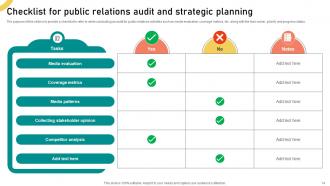
Slide 14: This slide is to provide a checklist to refer to while conducting an audit for public relations activities such as media evaluation, coverage metrics, etc.
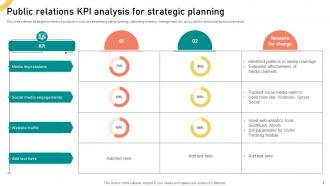
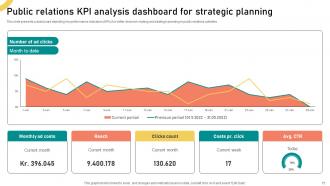
Slide 15: This slide presents a dashboard depicting key performance indicators (KPIs) for better decision-making and strategic planning in public relations activities.
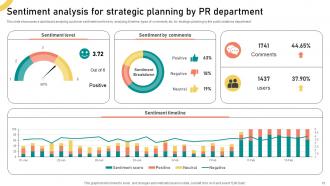
Slide 16: This slide showcases a dashboard analyzing customer sentiment over time by analyzing timeline, types of comments, etc.
Slide 17: This slide showcase title Strategically planned public relations announcement icon
Slide 18: This slide showcase title Icon for strategically planned public relations event.
Slide 19: This slide showcase title Strategic plan for social media PR icon
Slide 20: This is a Thank You slide with address, contact numbers and email address.
Public Relations Strategic Plan Powerpoint Ppt Template Bundles with all 28 slides:
Use our Public Relations Strategic Plan Powerpoint Ppt Template Bundles to effectively help you save your valuable time. They are readymade to fit into any presentation structure.









FAQs for Public Relations Strategic Plan Powerpoint
So there's basically three main goals you're shooting for: getting people to notice you, controlling how they see you, and making them actually do something. Whether that's buying stuff, donating, voting - whatever you need from them. Think of it like strategic storytelling, honestly. You'll also want to prep for when things inevitably blow up because they always do at some point (trust me on this one). I'd start by figuring out what "winning" looks like for each goal, then just work backwards from there to nail down your messaging and tactics.
Honestly, your target audience is like the GPS for your entire PR strategy. Figure out who you're talking to first, then everything else falls into place. Different groups consume media differently and have totally different problems they're trying to solve. You wouldn't waste time posting on LinkedIn trying to reach Gen Z, would you? That's just common sense. Create those detailed personas upfront - I know it sounds boring but trust me on this. Once you have those nailed down, your messaging and channel choices become way clearer.
Honestly, you can't build a decent PR strategy without knowing your audience first. Research shows you who actually matters to your brand and what makes them tick. Plus where they spend their time online (or offline). Without it? You're basically throwing spaghetti at the wall. The data reveals which messages will actually land, what channels are worth your time, and how people see you compared to competitors. Oh, and it'll help you catch trends before they become problems. I'd dig into whatever data you've got lying around first, then figure out what's missing.
Okay so first things first - figure out what your brand actually stands for, then make sure everything connects back to that. Really get to know your audience though. Like what actually stresses them out? What do they talk about when they're not at work? Skip the corporate jargon completely - nobody talks like that in real life. Your messaging needs to solve actual problems people have, not just push your stuff. Oh and consistency matters way more than you'd think. Everything should feel like it's coming from the same place. Honestly? Most brands try too hard to sell instead of just being helpful. I'd start by looking at what you're already saying and see where you can be more genuine about it.
Mix hard numbers with the softer stuff to get the real story. Media coverage volume, sentiment, website traffic from your PR push, social engagement - all that matters. Share of voice against competitors is probably my favorite metric though, shows if you're actually cutting through. Brand awareness surveys and stakeholder feedback give you the human side. Honestly, set your benchmarks first or you'll have nothing to compare against later. Don't go crazy tracking everything - pick maybe 3-5 metrics that actually match what you're trying to accomplish.
Honestly, you've gotta plan for disasters before they hit. Figure out what could really screw you over - data breaches, recalls, scandals, whatever. Then build playbooks with ready-to-go statements and decide who's gonna speak. Trust me on this one - I've seen companies completely fall apart because they weren't prepared. Set up monitoring so you catch problems early. Your crisis team needs to move fast, like within hours. Oh, and run practice drills quarterly - sounds boring but it actually helps. The whole thing is way less stressful when you're not scrambling to figure out basics during an actual crisis.
Look, the trick is making everything work together instead of treating them like separate things. Got a big media hit? Blast it on social immediately, throw it in your newsletter, feature it on your homepage. Your viral TikTok or Instagram story? That's perfect content to pitch as a trend piece to journalists. I always tell people to plan campaigns where your press release, social posts, and media pitches are all saying the same thing but in different ways. Most PR people don't even separate digital and traditional anymore - honestly it's kind of outdated thinking. Just figure out how each piece of content can be reformatted for different platforms.
Honestly, most PR teams just exist in their own bubble without knowing what the business actually wants. First thing - figure out the real goals. Revenue? Expanding into new markets? Whatever it is, make sure every campaign you do connects to that somehow. I usually draw up this super basic chart that shows how each PR thing ties to a business result. Sounds nerdy but it works. Meet with leadership regularly because priorities change like every month. The whole point is making coverage mean something beyond just "hey look we got mentioned in TechCrunch!" That stuff's useless if it doesn't move the needle.
Honestly, stakeholder engagement can make or break your PR. You've got employees, customers, media, investors - they all care about different stuff. I made this mistake once where we created gorgeous messaging that totally flopped because we didn't get what our audience actually wanted. Short sentences work. But you also need to figure out how each group prefers to communicate and how much sway they have over your success. Otherwise you're just throwing darts blindfolded and praying something sticks (which never works btw). Map out your top 5-7 groups first and what makes each one tick.
Look, nobody wants to read another boring press release about your new features. Stories are what actually stick - I mean, think about it, what do you remember better: some random stat or that crazy story your friend told you last week? Craft narratives around real customer transformations or those messy behind-the-scenes moments. Your company's mission journey works too. People connect with authentic stuff that shows your values in action, not corporate fluff. Start simple: pick 3-5 solid stories that prove your brand makes a difference. Then just work them into whatever PR stuff you're putting out there.
Okay so first grab a media monitoring tool - Mention or Brand24 work great for tracking what people say about you. Social media schedulers like Hootsuite are honestly a lifesaver, trust me on this one. Manual posting is torture. You'll also want a CRM for managing media contacts (super important for building relationships). Design stuff? Canva's perfect for quick graphics. Don't sleep on email marketing tools either - press releases won't send themselves. Analytics platforms help you see what's actually working. Most have free tiers, so start there and upgrade later when things get busier.
Honestly, you've gotta dig deep into local values and communication styles before doing anything. I bombed so hard once because I didn't do this homework first - embarrassing but learned my lesson! Partner with local PR people who actually get the cultural stuff. Direct messaging works in Germany but you'd look like a complete ass in Japan where they're all about subtlety. Your visuals, tone, even timing needs to match what locals expect. Oh and definitely test everything with focus groups there first. Sometimes you'll need to completely flip your approach, which sucks but it's better than failing publicly.
Start with media monitoring - track their coverage and what messages they're pushing across different outlets. Social listening tools are clutch for seeing engagement rates and how people actually feel about them. Crisis responses tell you a lot too, plus partnership announcements and thought leadership stuff. Google alerts for their executives is smart. Oh and honestly? Make a simple spreadsheet to track patterns over time instead of just randomly checking when you remember to. The systematic approach makes such a difference when you're trying to spot trends.
Honestly, don't just go for whoever has the most followers - that's such a waste of money. Find people whose audience actually matches who you're trying to reach. I learned this the hard way lol. Make sure they genuinely align with your brand too, because fake partnerships are so obvious and just look desperate. Let them do their thing creatively within your guidelines since their followers trust THEM, not you. Micro-influencers usually give you way better bang for your buck than celebrities anyway. Focus on engagement and how people actually respond, not just how many eyeballs you get. Build real relationships first before pitching anything.
Look, just be honest about everything - that's literally the foundation. Don't mislead people or mess with their emotions to get what you want. Privacy matters too, especially with personal stories. I've seen way too many campaigns blow up because they tried manipulating vulnerable groups or being fake about diversity. Would you want someone talking to you like this? That's your test right there. Think about how your messaging actually affects different communities, not just your client. Oh and represent people authentically - none of that performative checkbox stuff. Start every campaign asking "is this respectful and truthful?" Everything else flows from there.
-
The templates you provide are great! They have saved me tons of time and made my presentations come alive. Thank you for this awesome product. Keep up the good work!
-
Excellent design and quick turnaround.