Revenue And Expense Budget Gap Analysis With KPI Dashboard
Try Before you Buy Download Free Sample Product
Audience
Editable
of Time
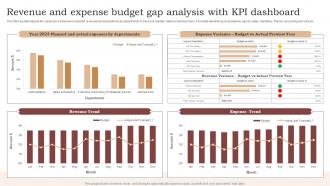
The following slide depicts the variances in actual and projected revenues and expenditures by departments to track and maintain balance between them. It includes elements such as salaries, payroll, sales, marketing, finance, accounting services etc.
People who downloaded this PowerPoint presentation also viewed the following :
Revenue And Expense Budget Gap Analysis With KPI Dashboard with all 7 slides:
Use our Revenue And Expense Budget Gap Analysis With KPI Dashboard to effectively help you save your valuable time. They are readymade to fit into any presentation structure.
FAQs for Revenue And Expense Budget Gap Analysis
Key components contributing to budget gap analysis include revenue forecasting accuracy, expense categorization, seasonal variations, market condition impacts, and resource allocation efficiency. These analytical elements work together by identifying spending patterns, revealing cost overruns, and highlighting revenue shortfalls, with many organizations finding that systematic gap analysis ultimately delivers improved financial control and strategic budget optimization.
Businesses can effectively identify budget gaps by comparing actual spending against planned budgets, analyzing variance reports, conducting departmental reviews, and tracking key performance indicators regularly. Through detailed financial analysis and forecasting tools, organizations streamline resource allocation, enhance operational efficiency, and minimize unexpected costs, with many companies finding that systematic gap identification ultimately delivers better budget control and strategic financial planning.
Budget gap analysis tools include Excel spreadsheets, QuickBooks, SAP Analytics Cloud, Oracle Hyperion, and specialized platforms like Adaptive Insights and Prophix. These solutions streamline financial modeling, automate variance calculations, and enhance reporting accuracy, with many organizations finding that integrated analytics platforms deliver real-time insights and improved forecasting precision.
Organizations should perform budget gap analyses monthly for detailed operational tracking, with quarterly reviews for strategic adjustments and annual comprehensive assessments for long-term planning. This tiered approach enables finance teams to identify variances early, implement corrective measures quickly, and maintain alignment with strategic objectives, with many companies finding that regular monitoring significantly enhances financial control and decision-making accuracy.
Neglecting budget gap analysis leads to poor resource allocation, unexpected cash flow shortages, missed investment opportunities, and inability to meet financial obligations on time. Organizations without regular gap analysis often face operational disruptions, reduced competitiveness, and strategic planning failures, with many companies finding that unaddressed budget variances compound over time, ultimately undermining long-term financial stability.
Non-profit organizations can leverage budget gap analysis by identifying funding shortfalls, prioritizing program needs, diversifying revenue streams, and aligning donor interests with organizational goals. Through systematic gap analysis, non-profits enhance grant applications, demonstrate fiscal responsibility to stakeholders, and develop targeted fundraising campaigns, ultimately delivering stronger community impact and sustainable growth in an increasingly competitive funding landscape.
Macroeconomic factors significantly influence budget gap assessments by affecting revenue projections, cost estimates, inflation rates, and economic growth assumptions. Changes in interest rates, unemployment levels, and market volatility directly impact organizational financial planning, with many companies finding that economic downturns widen budget gaps while growth periods enhance revenue opportunities and operational efficiency.
Stakeholder engagement ensures comprehensive data collection, identifies overlooked budget constraints, and builds consensus around gap analysis findings through collaborative input from finance teams, department heads, and executive leadership. This strategic involvement enhances accuracy by incorporating diverse perspectives, streamlines implementation of corrective measures, and ultimately delivers organizational buy-in for budget realignment initiatives across departments.
Budget gap analysis guides strategic decision-making by identifying funding shortfalls, prioritizing resource allocation, and revealing areas requiring immediate attention or investment cuts. Through systematic variance analysis, organizations can reallocate resources toward high-impact initiatives, adjust operational strategies, and make informed choices about expansion or cost reduction, ultimately enabling more precise financial planning and competitive positioning in increasingly dynamic markets.
Common pitfalls include relying on outdated data, overlooking seasonal variations, underestimating implementation costs, ignoring departmental interdependencies, and focusing solely on cost-cutting rather than revenue opportunities. These oversights can lead organizations to make misguided resource allocation decisions, with many companies finding that comprehensive analysis incorporating both historical trends and forward-looking projections delivers more accurate insights and sustainable financial strategies.
Scenario planning enhances budget gap analyses by modeling multiple financial futures, identifying potential revenue shortfalls and expense variations, and stress-testing budget assumptions against market uncertainties. Through dynamic forecasting, organizations can develop contingency strategies, allocate resources more strategically, and build financial resilience, with many companies finding that scenario-based planning delivers faster responses to economic shifts and ultimately stronger budget performance.
Key metrics include variance reduction percentage, actual vs. projected spending ratios, cost-per-unit improvements, revenue recovery rates, and timeline adherence for corrective actions. These indicators enable organizations to track financial stabilization, operational efficiency gains, and strategic goal alignment, with many companies finding that comprehensive metric dashboards ultimately deliver greater budget accuracy and improved resource allocation across departments.
Zero-based budgeting complements budget gap analysis by requiring every expense to be justified from zero, rather than using previous budgets as baselines, which helps identify true funding gaps versus habitual spending patterns. This approach enables organizations to uncover hidden inefficiencies, eliminate unnecessary costs, and reallocate resources more strategically, with many companies finding that zero-based methods reveal significant opportunities for closing budget gaps.
Variance analysis is crucial for understanding budget gaps as it systematically compares actual performance against planned budgets, identifying specific areas of overspending or underperformance through detailed financial examination. This analysis enables organizations to pinpoint operational inefficiencies, adjust resource allocation strategies, and implement corrective measures, with many companies finding that regular variance analysis ultimately delivers better financial control and more accurate future budgeting.
Visual data representation transforms budget gap communication by enabling stakeholders to quickly grasp complex variances through charts, graphs, heatmaps, and dashboards that highlight critical discrepancies at a glance. These visual tools streamline executive presentations, enhance board reporting, and facilitate faster decision-making across departments, with many organizations finding that visual formats reduce meeting times while improving comprehension and strategic alignment.
-
My presentations were a bit amateur before I found SlideTeam’s designs. I’ve been able to find slides for nearly every topic I’ve had to present. Thanks, Slideteam!
-
Wow, never been this impressed with any online service provider. Really appreciate the customer support all along from the navigation to purchasing the right products.