Review Dashboard For Talent Management Rating And Turnover Rate

Rating:
90%
Review Dashboard For Talent Management Rating And Turnover Rate Review Dashboard For Talent Management Rating And Turnover Rate
Slide 1 of 7

or

Favourites Favourites

Try Before you Buy Download Free Sample Product

Audience Impress Your
Audience
Editable 100%
Editable
Time Save Hours
of Time
The Biggest Sale is ending soon in
0
0
:
0
0
:
0
0
Rating:
90%
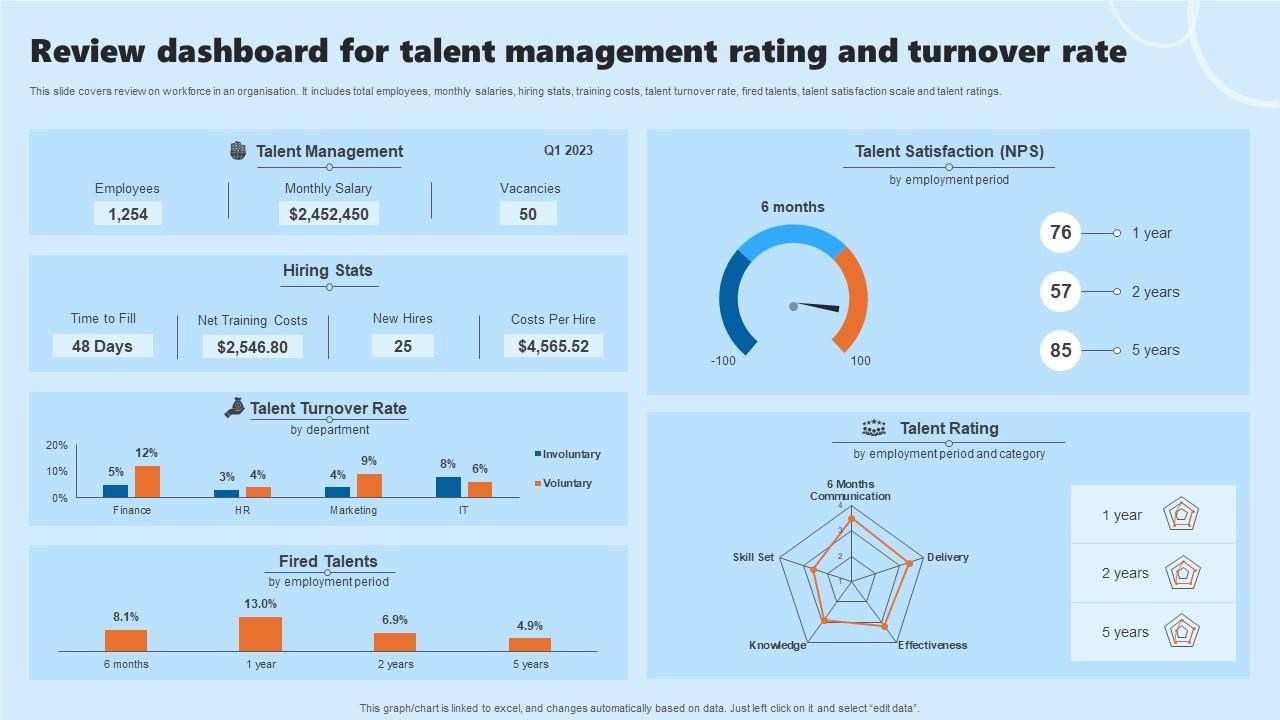
This slide covers review on workforce in an organisation. It includes total employees, monthly salaries, hiring stats, training costs, talent turnover rate, fired talents, talent satisfaction scale and talent ratings. Presenting our well structured Review Dashboard For Talent Management Rating And Turnover Rate. The topics discussed in this slide are Management, Dashboard, Turnover. This is an instantly available PowerPoint presentation that can be edited conveniently. Download it right away and captivate your audience.

FAQs for Review Dashboard For Talent Management Rating

Essential metrics include employee performance ratings, goal completion rates, skill development progress, retention rates, and engagement scores. These indicators streamline talent oversight by identifying high performers, tracking career advancement, and highlighting retention risks, with many organizations finding that comprehensive dashboards enhance strategic workforce planning and ultimately deliver improved employee experiences and competitive advantage.

A talent management dashboard helps organizations identify skills gaps by mapping current employee competencies against future business needs, analyzing performance data, and tracking skill assessments across departments. Through real-time analytics, companies can pinpoint specific areas where training is needed, prioritize upskilling initiatives, and strategically allocate development resources, ultimately enhancing workforce capabilities and competitive advantage.

Real-time data transforms talent management dashboards by providing immediate visibility into employee performance, engagement levels, recruitment metrics, and skill gaps as they occur. This instant access enables HR teams to make proactive decisions, identify retention risks early, and optimize workforce planning strategies, with many organizations finding that real-time insights significantly accelerate response times and enhance overall talent outcomes.

Visualizations in talent management dashboards enhance stakeholder engagement by transforming complex HR data into intuitive charts, graphs, and interactive displays that clearly communicate workforce trends, performance metrics, and talent gaps. Through visual storytelling, executives and HR leaders can quickly identify patterns in employee retention, skill development, and succession planning, while real-time dashboards enable faster decision-making and strategic workforce planning across organizations.

Integrating talent management dashboards with existing HR systems delivers streamlined data flow, enhanced analytics capabilities, reduced administrative overhead, improved decision-making accuracy, and seamless employee experience across platforms. This strategic combination enables organizations to automate talent processes, eliminate data silos, and accelerate workforce planning, with many companies finding significantly improved operational efficiency and competitive advantage.

Talent management dashboards facilitate succession planning by providing comprehensive visibility into employee skills, performance metrics, career trajectories, and leadership readiness across the organization. Through advanced analytics and real-time data visualization, HR teams can identify high-potential candidates, assess skill gaps, and create strategic development pathways, ultimately enabling seamless leadership transitions and organizational continuity.

Self-service features in talent management dashboards empower employees by enabling direct access to career development resources, performance feedback, goal tracking, and learning opportunities. These capabilities streamline professional growth by allowing staff to update profiles, enroll in training programs, and monitor progress independently, ultimately delivering greater autonomy and engagement while reducing administrative burden.

Organizations face implementation challenges including data integration complexity, employee privacy concerns, system adoption resistance, and insufficient analytics expertise. However, these obstacles can be overcome through phased rollouts, comprehensive training programs, and clear communication about benefits, with many companies finding that starting with pilot departments, establishing robust data governance frameworks, and involving HR teams in dashboard design ultimately delivers improved talent retention and strategic workforce planning capabilities.

Predictive analytics in talent management dashboards utilizes historical data, performance metrics, market trends, and business projections to forecast hiring needs, skill gaps, and succession requirements. Through machine learning algorithms and workforce modeling, organizations can anticipate turnover patterns, identify high-potential employees, and optimize recruitment strategies, ultimately enabling proactive talent decisions and competitive advantage.

Best practices for designing intuitive talent management dashboard interfaces include clear visual hierarchy, role-based customization, streamlined navigation, real-time data visualization, and mobile responsiveness. These design principles enhance user adoption by minimizing cognitive load, enabling quick decision-making, and providing personalized experiences, with many HR teams finding that intuitive interfaces significantly reduce training time and increase engagement across all organizational levels.

Organizations ensure data privacy and compliance in talent management dashboards through robust encryption, role-based access controls, regular security audits, and adherence to regulations like GDPR and CCPA. These measures streamline compliance processes while protecting sensitive employee information, with many HR departments finding that integrated privacy frameworks ultimately enhance trust, reduce legal risks, and enable more confident data-driven talent decisions.

Qualitative insights about workflow disruptions, specific feature requests from HR teams, and data accuracy concerns prove most valuable when refining talent management dashboards. These feedback types enable organizations to streamline user experience, enhance reporting capabilities, and improve data integration, with many HR departments finding that addressing navigation issues and customization needs ultimately delivers better employee insights and strategic workforce planning.

Benchmarking data enhances talent management dashboards by providing external context for performance metrics, salary comparisons, and industry retention standards, enabling more informed strategic decisions. Through comparative analytics, organizations can identify talent gaps, optimize compensation structures, and develop competitive retention strategies, with many companies finding that benchmarked insights significantly improve their ability to attract top performers.

Mobile accessibility ensures remote teams can access talent management dashboards from anywhere, enabling real-time performance tracking, goal updates, and feedback exchange regardless of location or device. This flexibility enhances manager-employee connectivity, accelerates decision-making processes, and maintains engagement consistency, with many distributed organizations finding that mobile-optimized dashboards deliver improved productivity and stronger team cohesion across geographical boundaries.

Organizations should review talent management dashboard data monthly for operational metrics like performance and engagement, while conducting comprehensive quarterly reviews for strategic assessments and annual updates for long-term planning cycles. This tiered approach enables HR teams to maintain current insights while tracking talent trends, succession planning progress, and workforce development outcomes, ultimately delivering responsive talent strategies and competitive advantage in dynamic business environments.

Ratings and Reviews

90% of 100
Review Form
Write a review
Most Relevant Reviews
  1. 80%

    by Clifton Jenkins

    Great product, helpful indeed!
  2. 100%

    by Darwin Mendez

    I’m not a design person, so I couldn’t make a presentation to save my life. Thankfully, they have all kinds of templates that I regularly use for my work.

2 Item(s)

per page: