Three Phases Of ITIL Problem Management Process
Try Before you Buy Download Free Sample Product
Audience
Editable
of Time
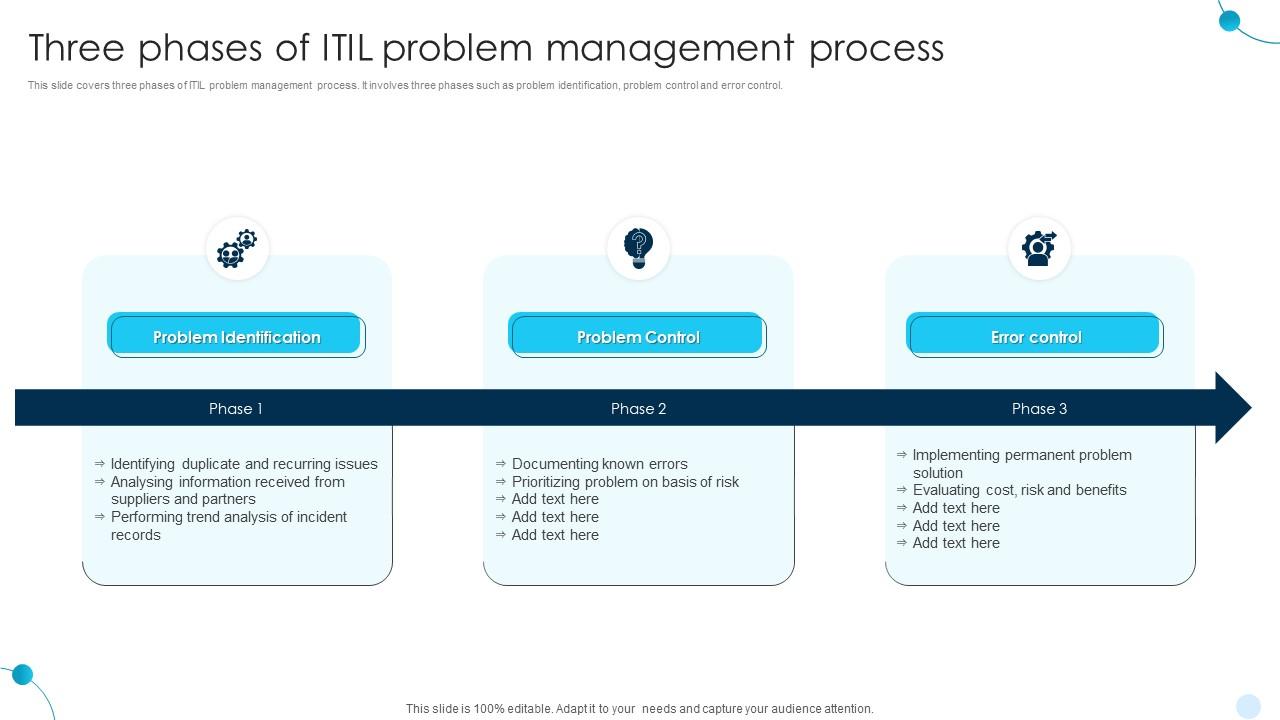
This slide covers three phases of ITIL problem management process. It involves three phases such as problem identification, problem control and error control.
People who downloaded this PowerPoint presentation also viewed the following :
Content of this Powerpoint Presentation
Technology falls prey to glitches and errors, and no matter how advanced a company’s technical infrastructure may be, minor annoyances and major disasters are an unavoidable part of the corporate IT experience. ITIL (Information Technology Infrastructure Library) problem management is a corporate framework deeply relevant to this specific issue. It utilizes a systematic and structured process to scrutinize IT grievances, incorporate substantial remedies, and prevent future recurrences to keep the gears of the machine rolling no matter how large or how significant a technical issue arises during a company’s day-to-day operations.
Click here for a more thorough PowerPoint focused on this subject.
We present to you a simple one-page template on ITIL problem management to master the art of IT problem-solving within your office space. Implement a comprehensive engagement process that can probe any underlying issues and build organizational resilience to prevent similar problems from arising. Do this and more with the well-researched content laid out for you in these slides.
Template 1: Three Phases of ITIL Problem Management Process

Weaponize the ITIL process to achieve stronger results in the software domain, all with the help of this concise slide. It has been segmented into three principal phases central to the broader process - problem identification, problem control, and error control. Use this to ensure a more streamlined and integrated process for technical issues in the IT domain.
Click here and check out our other ready-to-use template on the ITIL problem management process now.
Conclusion
Technology has become a core component of business operations. Embracing the core principles of this problem management framework can help an organization grow and expand its operating capacities, building an optimized and resilient service that performs better in our current digital environment. Download these slides and utilize them to get ahead in this specific arena with ease, harnessing the content of the slides as you outcompete your rivals.
Click here to access tailor-made PPT Templates for the ITIL change management process.
Three Phases Of ITIL Problem Management Process with all 6 slides:
Use our Three Phases Of ITIL Problem Management Process to effectively help you save your valuable time. They are readymade to fit into any presentation structure.
FAQs for Three Phases Of ITIL
Look, you're basically being a detective here - finding why stuff keeps breaking instead of just fixing it over and over. Problem management is way more proactive than incident response. You want to catch issues before they blow up into actual incidents, which honestly saves everyone a headache. Keep a database of known problems with quick fixes so your team isn't scrambling every time. The big win? Fewer tickets hitting your service desk overall. Start by checking your incident patterns - that's where you'll spot the real troublemakers. Oh, and don't just slap band-aids on symptoms when you could fix the root cause.
So Incident Management is all about putting out fires - get the email server back up, fix the network outage, whatever gets people working again. Super reactive stuff. Problem Management is totally different though - it's like being a detective after the chaos dies down. Why did that server crash anyway? Was it ancient hardware finally giving up? Bad config? That's what Problem Management figures out and actually fixes so you're not dealing with the same headache next month. Honestly, most places are way better at the first part than the second.
So Problem Management breaks down into a few key things: identifying problems, investigating them, putting workarounds in place, and doing root cause analysis. You'll also create known errors and track resolutions. Investigation is honestly where teams get stuck the most - it's detective work but with way more documentation. Coordination with other teams is huge, and you've got to keep that known error database updated so you're not scrambling when the same issue pops up again. Oh, and definitely get tight with your technical teams early. Trust me, you'll need them constantly for the root cause stuff.
Don't just patch the obvious stuff - you've gotta find the real patterns behind these incidents. Group similar ones together and see what they have in common. Yeah, it's boring work but that's where you actually solve things. Try the 5 Whys method or those fishbone diagrams (sounds weird but they work). Your monitoring tools will catch trends, but honestly? Talk to the people dealing with this crap every day. They usually know stuff the data misses. Just be systematic about it instead of throwing random fixes at the wall.
So the Knowledge Base is where you dump all your problem management stuff - known errors, workarounds, root cause findings, whatever. Honestly it's a game changer for recurring issues because you don't have to start from scratch every damn time. Just look up what worked before. I always tell people to check it first before diving into any investigation - saves you hours. Oh and actually update it when you find new solutions, otherwise it becomes useless pretty fast. Trust me on that one.
Track your problem counts first - how many you've found, fixed, and what's still hanging around. Resolution times matter too, especially if you've got targets to hit. But here's the thing that actually counts: are you preventing stuff from breaking again? Look at repeat incidents and whether major outages are dropping. I'd also check if your root cause investigations are decent quality and if anyone's bothering to implement the fixes you suggest. That's honestly where most teams fall down. The whole point is fewer fires to fight because you tackled the real issues underneath.
So basically, instead of just fixing the same annoying issues over and over, Problem Management digs into why they keep happening in the first place. Way smarter approach if you ask me. You stop those repeat problems that drive everyone crazy and waste tons of time. Think of it like actually fixing a broken faucet instead of constantly wiping up the mess. Plus you'll build up this solid knowledge base - honestly makes everything so much easier when the whole team can quickly look up solutions. I'd start by tracking which incidents won't go away and focus there first.
Most companies use ServiceNow, Remedy, or Jira Service Management for this stuff - they track problems, link incidents, the whole nine yards. For root cause analysis, some teams get fancy with Kepner-Tregoe or fishbone diagrams, but honestly that depends on your team's appetite for detail. Monitoring tools like Splunk or Nagios can feed useful data into the mix too. My advice? Just start with whatever ITSM tool you're already stuck with and expand from there. No point reinventing the wheel.
Oh totally, collaboration is a game changer for problem management. Different teams catch things others miss - like dev spots weird code patterns while infrastructure notices server issues. When everyone shares their data and expertise, you find root causes way faster. Plus nobody gets stuck playing hot potato with problems (which honestly happens way too often). Cross-team problem reviews are clutch, and giving everyone access to the same dashboards helps too. You'll also end up with way better documentation since multiple people contribute their knowledge to those problem records.
Dude, proactive problem management is basically playing detective with your IT stuff before everything goes to hell. You hunt through incident data looking for patterns - like "oh weird, this server dies every Tuesday" - then fix the actual root cause during maintenance windows. Way better than just waiting around for things to break, honestly. Pick your top 3 recurring incidents from this month and start there. Set aside time each week to dig into reports and ask what's really causing the repeat issues. It's surprisingly satisfying when you catch a memory leak before users even notice.
Honestly, the tech part isn't what'll trip you up - it's getting people to change how they work. Most teams just want to put out fires and move on, so convincing them to actually document stuff properly is like pulling teeth. Different departments hate collaborating too, especially if they're used to doing their own thing. Oh, and everyone totally underestimates how long proper investigations take. Start with whatever incident keeps making your life hell - once you fix that, people will actually listen to you about rolling out the rest of the process.
So basically, Problem Management gives Change Management the real dirt on what's actually broken. You find root causes, then boom - you've got solid reasons for your change requests instead of just "hey we should probably fix this thing." Way better than just tackling whatever fire is screaming loudest that day (which honestly happens more than it should). Those problem records? They're gold for building business cases and getting the resources you need. Document your root causes properly and suddenly your change requests have actual teeth when you're trying to get buy-in from management.
Document your bugs with titles people can actually search for and describe symptoms in detail. Root cause + step-by-step workarounds are clutch. Honestly, half the knowledge base articles I've seen are total garbage because they're way too vague. Don't forget error codes and config details - that stuff saves hours later. Test your workarounds before you publish them (learned that one the hard way). Update the status when fixes go live and link related incidents. Write like you're explaining to someone who's completely new to the issue. Keep it simple and actionable.
Problem Management works with other ITIL processes by sharing data and coordinating handoffs. Once you find the root cause, Change Management handles approvals and scheduling while you provide the technical fix. Configuration Management is honestly your lifeline here - good CMDB data makes everything so much easier when you're tracking which CIs are affected or spotting incident patterns. You'll want clear handoff points between processes. Link your problem records to related changes and CIs too. Oh, and definitely map out where these processes already intersect in your current workflows first.
Start with ITIL Foundation - that's your baseline. You're gonna need solid analytical skills since it's basically detective work for tech problems. Communication is huge too because you'll constantly be dealing with different teams who probably don't want to talk to each other. Technical knowledge of whatever systems you're working with is obvious, but project management experience actually helps more than people realize. Complex problems turn into these weird mini-projects really fast. Tools like ServiceNow are pretty standard now. Honestly, try to shadow someone experienced first - the day-to-day reality is way different than what the cert books tell you.
-
Love how there are no boring templates here! The design is fresh and creative, just the way I like it. Can't wait to edit and use them for my extended projects!Â
-
I can always count on your designs for my professional needs. I believe I found a one-stop-shop for PPTs.