

Vendor Compliance Risk Statistical Analysis Dashboard Supplier Risk Management




Try Before you Buy Download Free Sample Product
 Impress Your
Audience
 100%
Editable
 Save Hours
of Time


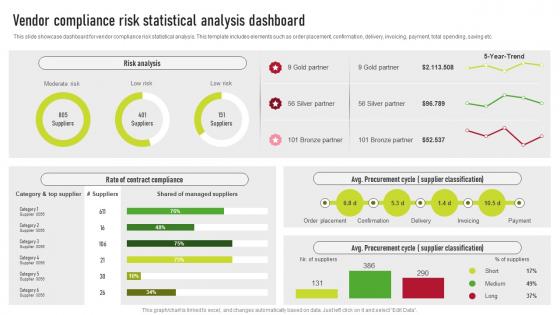
This slide showcase dashboard for vendor compliance risk statistical analysis. This template includes elements such as order placement, confirmation, delivery, invoicing, payment, total spending, saving etc.
People who downloaded this PowerPoint presentation also viewed the following :
Vendor Compliance Risk Statistical Analysis Dashboard Supplier Risk Management with all 10 slides:
Use our Vendor Compliance Risk Statistical Analysis Dashboard Supplier Risk Management to effectively help you save your valuable time. They are readymade to fit into any presentation structure.










FAQs for Vendor Compliance Risk Statistical Analysis Dashboard
Key components of vendor compliance risk include regulatory adherence, data security protocols, financial stability assessments, operational performance standards, and contractual obligation fulfillment. These elements work together by enabling comprehensive oversight, minimizing regulatory exposure, and ensuring service continuity, with many organizations finding that proactive monitoring across these areas ultimately delivers enhanced operational efficiency and reduced liability exposure.
Companies can effectively assess vendor compliance capabilities through comprehensive due diligence processes, regular audits, compliance questionnaires, third-party certifications review, and ongoing monitoring systems. These assessment methods enable organizations to evaluate regulatory adherence, risk management practices, and operational controls across their supply chain, with many financial services and healthcare institutions finding that structured vendor assessment frameworks ultimately deliver reduced compliance risks and enhanced regulatory confidence.
Technology enhances vendor compliance risk management through automated monitoring systems, real-time data analytics, digital audit trails, compliance dashboards, and AI-powered risk assessment tools. These solutions streamline vendor evaluations by providing continuous oversight, predictive risk modeling, and instant regulatory updates, with many financial institutions and healthcare organizations finding that automated compliance tracking reduces manual errors while delivering faster vendor onboarding and enhanced regulatory transparency.
Organizations establish vendor compliance programs through comprehensive risk assessment frameworks, standardized evaluation criteria, continuous monitoring systems, and regular audit protocols. By implementing structured onboarding processes, automated compliance tracking, and clear contractual requirements, companies across sectors like healthcare, financial services, and manufacturing enhance operational transparency, minimize regulatory exposure, and ultimately deliver stronger stakeholder confidence while maintaining competitive advantage.
Common vendor compliance pitfalls include inadequate due diligence processes, inconsistent monitoring frameworks, poor documentation practices, and lack of regular audit schedules. These oversights often result in regulatory violations, financial penalties, and reputational damage, with many organizations finding that implementing automated compliance tracking and standardized vendor assessment protocols significantly reduces risk exposure while streamlining oversight operations.
Regulatory changes significantly elevate vendor compliance risk by introducing new requirements, altering existing standards, and creating potential gaps in current vendor agreements and practices. Organizations must continuously reassess their vendor relationships, update compliance frameworks, and implement enhanced monitoring protocols, with many financial services and healthcare institutions finding that proactive regulatory tracking ultimately delivers stronger vendor oversight and reduced compliance exposure.
Organizations should track metrics including compliance audit scores, incident frequency rates, response time to compliance issues, regulatory violation counts, and contract adherence percentages. These measurements enable businesses to identify high-risk vendors, streamline oversight processes, and enhance supplier relationships, with many companies finding that systematic tracking reduces compliance costs while improving operational efficiency and regulatory standing.
Organizations ensure effective vendor compliance communication through regular training sessions, standardized documentation requirements, automated reporting systems, and dedicated compliance liaisons. Through digital platforms and structured quarterly reviews, companies like financial institutions and healthcare providers streamline protocol updates, monitor adherence in real-time, and maintain transparent communication channels, ultimately delivering consistent compliance standards and reducing regulatory risks.
Mitigating vendor non-compliance risk involves establishing comprehensive due diligence processes, implementing regular monitoring and audit schedules, creating clear contractual obligations with defined penalties, and maintaining ongoing communication channels. These strategies enable organizations to proactively identify potential issues, ensure regulatory adherence, and maintain operational continuity, with many companies finding that structured vendor management programs significantly reduce compliance violations and associated costs.
Vendor compliance audits should typically be conducted annually for standard vendors, quarterly for high-risk suppliers, and continuously for critical business partners through automated monitoring systems. Many organizations implement risk-based scheduling, with financial services and healthcare sectors finding that frequent assessments reduce regulatory violations, strengthen vendor relationships, and ultimately deliver enhanced operational security and competitive advantage.
**INPUT**: What frameworks or standards can assist in developing a robust vendor compliance strategy? **OUTPUT**: Robust vendor compliance strategies leverage frameworks like ISO 27001 for information security, SOC 2 for operational controls, NIST Cybersecurity Framework, GDPR for data protection, and industry-specific standards like PCI DSS. These frameworks streamline risk assessment, enhance due diligence processes, and establish consistent monitoring protocols, with many organizations finding that standardized approaches significantly reduce compliance gaps while strengthening vendor relationships. [Word count: 60 words]
Organizations foster vendor compliance culture through clear communication of expectations, regular training programs, performance incentives tied to compliance metrics, and collaborative partnership approaches rather than purely punitive measures. By implementing structured onboarding processes, continuous monitoring systems, and recognition programs for compliant vendors, companies create environments where compliance becomes integral to business relationships, ultimately delivering stronger risk management, operational consistency, and sustained competitive advantage across their entire supply chain ecosystem.
Non-compliance at the vendor level can result in regulatory fines, legal liability, operational disruptions, reputational damage, and contract terminations for companies. These consequences often cascade across supply chains, with organizations in healthcare, financial services, and manufacturing finding that vendor violations can trigger audits, customer loss, and increased oversight costs, ultimately compromising competitive positioning.
**INPUT**: How can collaboration between vendors and procurement teams improve compliance outcomes? **OUTPUT**: Collaboration between vendors and procurement teams enhances compliance outcomes by establishing clear communication channels, implementing joint monitoring systems, and creating shared accountability frameworks. Through regular compliance reviews and coordinated training programs, organizations streamline vendor onboarding, reduce regulatory violations, and accelerate issue resolution, with many companies finding that strategic partnerships ultimately deliver stronger risk management and operational efficiency.
**INPUT**: What strategies can be employed to manage compliance risk in a global vendor network? **OUTPUT**: Managing compliance risk in global vendor networks involves standardized assessment frameworks, continuous monitoring systems, centralized documentation platforms, regular audits, and clear contractual requirements across all jurisdictions. These strategies enable organizations to streamline oversight, ensure regulatory adherence, and maintain operational consistency, with many multinational companies finding that integrated compliance management ultimately delivers reduced risk exposure and enhanced vendor relationships.
-
Thrilled to see several customizable templates catering various verticals and industries.
-
Excellent design and quick turnaround.