


Warehouse kpis backorder rate order lead time inventory accuracy




Try Before you Buy Download Free Sample Product
 Impress Your
 Audience
 100%
100% Editable
 Save Hours
 of Time


Our Warehouse Kpis Backorder Rate Order Lead Time Inventory Accuracy help convey huge amounts of data. It caters for an insatiable hunger for information.
People who downloaded this PowerPoint presentation also viewed the following :
Content of this Powerpoint Presentation
Description:
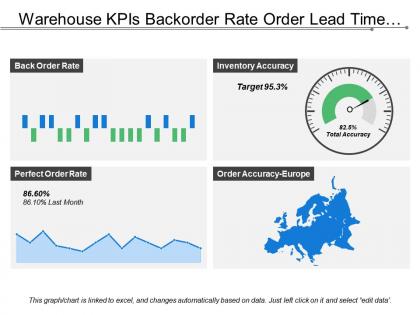
This image depicts a dashboard summarizing several Key Performance Indicators (KPIs) pertinent to warehouse management. These KPIs include the Back Order Rate, represented by a bar graph that shows fluctuations over time; the Inventory Accuracy, visualized by a gauge displaying the current metric against a target value; the Perfect Order Rate, indicated by a line graph that highlights performance over time and comparison to the previous month; and Order Accuracy within Europe, with a map visual that doesn't show specific data but implies region-specific tracking.
The note at the bottom indicates that the graphs and charts are dynamically linked to an Excel spreadsheet, meaning that they will update automatically when the underlying data is altered. Such a feature is handy for real-time monitoring and reporting.
Use Cases:
These indicators are crucial for monitoring the efficiency and reliability of supply chain operations. Here are seven industries where this kind of reporting tool could be applied:
1. Manufacturing:
Use: Tracking production and supply chain efficiency for optimized output and cost reduction.
Presenter: Operations Manager.
Audience: Supply Chain Analysts, Department Heads, Senior Management.
2. Retail:
Use: Managing inventory and order fulfillment to enhance customer satisfaction and profitability.
Presenter: Inventory Manager.
Audience: Store Managers, Regional Coordinators, Sales Associates.
3. E-Commerce:
Use: Analyzing fulfillment and return processes to improve efficiency and reduce costs.
Presenter: E-Commerce Operations Manager.
Audience: Customer Service Teams, Fulfillment Center Staff, Web Developers.
4. Logistics:
Use: Monitoring shipment and delivery performance to ensure on-time deliveries and client satisfaction.
Presenter: Logistics Director.
Audience: Distribution Partners, Logistic Coordinators, Sales teams.
5. Pharmaceuticals:
Use: Ensuring timely stock replenishment and managing regulatory compliance to maintain safe and efficient supply chains.
Presenter: Supply Chain Compliance Officer.
Audience: Pharmacy Managers, Healthcare Supply Chain Analysts, Regulatory Agencies.
6. Automotive:
Use: Optimizing parts inventory and delivery to production lines for smooth, on-time vehicle assembly.
Presenter: Plant Manager.
Audience: Procurement Teams, Inventory Specialists, Production Floor Supervisors.
7. Food and Beverage:
Use: Controlling perishable inventory and tracking order deliveries to maintain freshness and meet customer demands.
Presenter: Warehouse Manager.
Audience: Quality Assurance Teams, Distributors, Sales Representatives.
Warehouse kpis backorder rate order lead time inventory accuracy with all 5 slides:
Guide folks to generate creative ideas with our Warehouse Kpis Backorder Rate Order Lead Time Inventory Accuracy. Encourage them to indulge in brainstorming.




FAQs for Warehouse kpis backorder rate order lead
Critical warehouse efficiency KPIs include order accuracy rates, inventory turnover, pick and pack times, shipping accuracy, and cost per order fulfillment. These metrics streamline operations by identifying bottlenecks, optimizing labor allocation, and reducing operational costs, with many distribution centers finding that tracking these KPIs simultaneously delivers faster customer service and significant competitive advantages.
Inventory turnover rates significantly impact warehouse performance by determining storage costs, cash flow efficiency, and operational productivity throughout the facility. Higher turnover rates reduce holding costs, minimize obsolescence risks, and optimize space utilization, while lower rates can indicate overstocking or demand forecasting issues, ultimately affecting profitability and competitive positioning in increasingly dynamic markets.
KPIs enable warehouse managers to optimize order fulfillment by tracking pick accuracy rates, order cycle times, shipping errors, labor productivity, and inventory turnover metrics. Through real-time monitoring of these indicators, distribution centers streamline picking routes, reduce processing delays, and enhance customer satisfaction, with many e-commerce and retail operations finding that strategic KPI implementation delivers faster deliveries and significantly lower operational costs.
Technology enhances warehouse KPI tracking through automated data collection systems, real-time dashboards, IoT sensors, RFID tracking, and integrated warehouse management software. These solutions streamline monitoring of inventory accuracy, order fulfillment rates, and operational efficiency by eliminating manual processes, providing instant visibility, and enabling predictive analytics, ultimately delivering faster decision-making and improved warehouse performance.
Best practices for setting warehouse KPIs include establishing baseline measurements, aligning metrics with strategic objectives, implementing real-time tracking systems, setting achievable yet challenging targets, and ensuring cross-functional stakeholder input. These approaches streamline performance management by creating accountability, enabling data-driven decisions, and fostering collaborative improvement culture, with many logistics organizations finding that balanced scorecards ultimately deliver sustained operational excellence.
Labor productivity metrics influence warehouse operations by identifying bottlenecks, optimizing staffing levels, and streamlining workflow processes across picking, packing, and shipping activities. These measurements enable managers to reduce operational costs, minimize order fulfillment times, and enhance customer satisfaction, with many distribution centers finding that strategic labor optimization delivers significant competitive advantages.
**INPUT**: What KPIs should be prioritized to reduce shipping errors in a warehouse? **OUTPUT**: Priority KPIs for reducing shipping errors include order accuracy rate, pick accuracy percentage, shipping damage frequency, on-time delivery performance, and inventory accuracy levels. These metrics enable warehouses to streamline operations by identifying bottlenecks, enhancing quality control processes, and optimizing staff training, with many logistics companies finding that focused KPI monitoring delivers faster fulfillment and improved customer satisfaction. **Word count: 58 words**
Safety metrics integrate into warehouse KPI reporting through automated incident tracking, real-time safety score dashboards, and comprehensive analytics that connect safety performance to operational efficiency. Modern warehouse management systems enable seamless integration by tracking near-misses, accident rates, and compliance scores alongside productivity metrics, ultimately delivering safer working environments while maintaining competitive operational performance.
Customer satisfaction metrics serve as warehouse KPIs by measuring order accuracy, delivery timeliness, product condition upon arrival, return rates, and customer complaint resolution speed. These metrics directly reflect warehouse performance in inventory management, picking processes, and packaging quality, with many logistics companies finding that tracking customer feedback scores, Net Promoter Scores, and repeat purchase rates ultimately delivers enhanced operational efficiency and competitive advantage.
Lead time is significant because it measures the total time from order placement to delivery, directly impacting customer satisfaction, inventory planning, and operational efficiency. By tracking lead time, warehouse managers can identify bottlenecks, optimize picking and packing processes, and enhance supply chain coordination, with many logistics companies finding that reduced lead times deliver competitive advantage and improved customer retention rates.
KPIs reveal warehouse bottlenecks by tracking metrics like order processing time, inventory turnover rates, picking accuracy, and labor productivity across different operational zones. Through systematic analysis of these performance indicators, businesses can pinpoint specific areas causing delays, whether in receiving, storage, or fulfillment processes, ultimately enabling targeted improvements that streamline operations and enhance overall efficiency.
Effective warehouse KPI tracking tools include warehouse management systems (WMS), business intelligence platforms like Tableau and Power BI, IoT sensors, barcode/RFID scanners, and integrated ERP solutions. These technologies streamline operations by automating data collection, providing real-time dashboards, and enabling predictive analytics, with many logistics companies finding that comprehensive tracking ultimately delivers improved accuracy and operational efficiency.
Return rates significantly impact warehouse efficiency assessment by revealing reverse logistics costs, inventory management accuracy, product quality control, and customer satisfaction levels. High return rates strain operational capacity through additional receiving, inspection, and restocking processes, while low rates indicate effective quality assurance and order fulfillment, with many distribution centers finding that minimizing returns ultimately enhances overall throughput and profitability.
Seasonal fluctuations should be accounted for by establishing baseline metrics for peak and off-peak periods, implementing rolling averages, and setting dynamic benchmarks that adjust for predictable demand variations. Retailers and e-commerce companies increasingly use year-over-year comparisons alongside seasonal indexing, enabling more accurate performance assessments while maintaining operational efficiency during high-volume periods like holidays.
Common pitfalls include tracking too many metrics simultaneously, focusing solely on individual performance rather than team outcomes, setting unrealistic targets without baseline data, neglecting employee input during KPI selection, and failing to align metrics with broader business objectives. Many warehouses find that overcomplicating measurement systems creates confusion rather than clarity, while successful operations prioritize 5-7 key metrics that directly impact customer satisfaction, operational efficiency, and cost control, ultimately delivering sustainable performance improvements.
-
Wonderful templates design to use in business meetings.
-
Designs have enough space to add content.